Mundra (23.06.2026): There was a time till late 1990s when Mundra was easy to miss—a quiet fishing village on India’s western edge, with no highways, no industry, and little to signal its future. Yet history hints that this arid region of Kutch with its marshy coastline was never just an ordinary outpost. For nearly two centuries, it quietly punched above its weight, sending Kachchhi ships (vessels from Kutch) across the Arabian Sea and linking Gujarat’s markets with ports like Muscat and Zanzibar.
But colonial trade realignments changed that story. As Bombay rose under British policy, smaller ports like Mundra faded into the background. What remained, however, was its greatest asset: geography—a deep, natural coastline waiting for reinvention.
That reinvention began in 1998 when the Adani Group spotted an opportunity to improve maritime efficiencies. As Gujarat opened its ports to private investments, a bold idea took shape—to build not just a port, but an integrated economic ecosystem. Early development was modest: a few berths, basic cargo handling, and road links. But momentum built quickly.
What stands today is transformational:
By the mid-2000s, Mundra had become a magnet. Industry didn’t just pass through—it settled, integrated, and expanded.
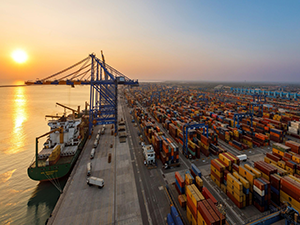
Mundra is no longer a port in isolation—it is a convergence of logistics, manufacturing, energy, and trade. Giant cranes dominate the skyline, container yards stretch for miles, and rail lines feed cargo deep into the hinterland.
The port evolved into the nucleus of a Special Economic Zone where land, power, and connectivity come together in one place. Mundra Port is the gateway for cargo to the Northern hinterland and Mundra SEZ is the gateway for the Indian exports. Around it, power plants, industrial units, and warehouses have created a self-sustaining economic cluster.
Today, Mundra handles around 11% of India’s maritime cargo and nearly a third of its container —making it one of South Asia’s most critical trade gateways.
But its significance goes beyond numbers. Mundra anchors supply chains, powers industries, and secures energy flows for a fast-growing economy.
Businesses are no longer coming here just for exports or imports. They’re setting up entire value chains—production, storage, processing, and distribution—within the same geography. This clustering effect is turning Mundra into a self-sustaining economic zone.
Linked to the northern hinterland through rail — especially the Western Dedicated Freight Corridor — and now, through air with the launch of Adani Mundra Airport’s inaugural scheduled flight services connecting Mumbai and Goa, Mundra is set to unlock unprecedented economic potential for the Kutch region, creating greater synergies for new businesses and tourism, further boosting the Mundra-spiral.
In many ways, Mundra is replicating a global model: where ports don’t just move goods, they anchor industries. Over time, Mundra has effectively revived India’s maritime trade routes, echoing a time when the country commanded global commerce across the seas.
This was not an organic transformation. It was deliberate.
Mundra hasn’t evolved. It has been engineered—into the gateway India didn’t just inherit but built on to achieve new frontiers in maritime trade.