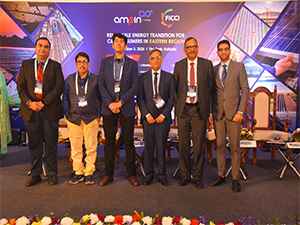
Kolkata / New Delhi (06.12.2025): Eastern India is poised to become a high-growth hub for renewable energy, as underscored at a high-level dialogue in Kolkata organised by FICCI. The region is witnessing increasing momentum toward large-scale clean energy adoption, driven by policy focus, improving infrastructure, and rising industrial and commercial demand.
The Federation of Indian Chambers of Commerce and Industry (FICCI) and Credit Rating Information Services of India Limited (CRISIL) together with AMPIN Energy Transition and in collaboration with Sumitomo Corporation India, along with key industry leaders, highlighted how policymakers, utilities, developers, and stakeholders are jointly working to unlock Eastern India’s renewable energy potential. The discussions focused on accelerating capacity addition, strengthening grid integration, and steering the region’s transition toward a sustainable, resilient, and future-ready energy ecosystem.
Against this backdrop, FICCI and CRISIL convened a high-level dialogue in Kolkata on Renewable Energy Transition for Commercial and Industrial (C&I) Consumers in the Eastern Region, bringing together policymakers, regulators, utilities, developers and industry leaders. With rising industrial demand, evolving state policies and growing interest in competitive green power, the East is poised to play a pivotal role in India’s clean-energy trajectory.
Delivering the inaugural address, Arun Goyal, former Secretary to Government of India and former member of Central Electricity Regulatory Commission (CERC) said, “If India’s Eastern Region has to transform its renewables potential into reliable industrial power, we must not only build capacity, we must build connectivity. Unless intrastate network bottlenecks are resolved and transmission infrastructure modernised with private participation, even the best-capacitated solar or wind projects cannot deliver for C&I consumers.”
Pinaki Bhattacharyya, Co-Chair, FICCI Renewable Energy CEOs Committee and Founder, CEO & Managing Director, AMPIN Energy Transition, highlighted that Eastern India’s renewable push is gaining traction as more states introduce investor-friendly policies and industries seek to adopt low-carbon operations. The eastern region hosts some of India’s biggest load centres, and renewables are now among the most cost-effective energy sources for C&I customers. He noted that across India, RE adoption is increasingly being driven by C&I consumers who are focused on lowering energy costs and improving long-term sustainability.
Representing state-level leadership, Syedain Abbasi, Chairman, Assam Power Distribution Company Ltd, emphasised that Eastern India is witnessing rapid expansion of renewable infrastructure, supported by state initiatives such as grid strengthening, rooftop solar promotion and storage-ready planning. He underlined that states like Assam are working to create a balanced energy ecosystem capable of meeting rising industrial demand.
Addressing the importance of grid stability, Sanjiv Shrivastava, ED Commercial, Damodar Valley Corporation, explained that India’s energy transition requires synchronised development of RE capacity, storage, flexible demand management and modernization of grid operations. He noted that Eastern India’s industrial belt provides a strong foundation for RE-linked economic expansion.
Providing a national perspective, Alok Kumar, Former Secretary, Ministry of Power, Government of India, noted that C&I consumers across India are driving major shifts in the demand for clean, reliable and cost-competitive power. He stated that industries adopting flexible and firm RE-backed solutions are expected to lead India’s transition to a low-carbon economy.
From a regulatory standpoint, S K Chatterjee, Chief, Regulatory Affairs, CERC, highlighted that India’s future energy system will rely heavily on flexibility, decentralised solutions and advanced digital technologies. He referenced global practices where smart grids, VPPs and responsive demand play a key role in integrating higher shares of renewables.
Representing the state utility perspective from Odisha, Dr Satyapriya Rath, Managing Director, GRIDCO, noted that Eastern India has traditionally supplied conventional power to the country and is now poised to lead in renewable and flexible generation as well. He explained that with policy alignment, utility readiness and industrial demand, the region is well-positioned for a major shift.
Joy Chakrabarty, Divisional Engineer, West Bengal Renewable Energy Development Agency (WBREDA), backed by WBREDA’s publicly available mission and role, said “For Eastern India to truly unlock the potential of Green Open Access and distributed renewables, state led agencies like WBREDA must ensure that regulatory clarity, grid readiness and enabling infrastructure go hand in hand with project rollout. Only then will commercial and industrial consumers feel confident to invest in clean energy, whether via rooftop, captive, or open access routes.
Sharing market insights, Pranav Master, Director, Energy and Sustainability, CRISIL, noted that C&I demand for renewable power is rising steadily across India as companies aim to align with ESG commitments, supply-chain expectations, and cost-competitive power procurement models.
The event concluded with remarks by FICCI Director Arpan Gupta, who highlighted that the Eastern region is driving India's clean energy transition, where technological innovation and industrial ambition are aligning with government vision like never before.