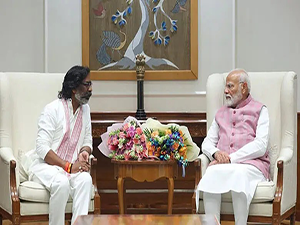
New Delhi (24.06.2026): In what has emerged as a classic case of policy on paper, politics on ground, a crucial Central initiative aimed at boosting tribal farmers' income and tackling nutritional deficiencies in Jharkhand has hit a bureaucratic dead end. Designed to ensure the guaranteed procurement of pulses—specifically arhar (pigeon pea) and urad (black gram)—the project remains a non-starter over a year after its conception, trapped in an apparent deadlock between the Centre and the state government.
Keeping in view the apprehensions and unwillingness of Hemant Soren Govt the Centre has reportedly slowed down its pursuance seeking its consent on “procurement centres”.
Under the blueprint, the National Co-operative Consumers' Federation of India Ltd (NCCF), under the Department of Consumer Affairs, was tasked with piloting the project across key Naxal-affected and tribal pockets. The initiative aimed to incentivize crop diversification, provide a guaranteed market for pulse cultivators, and improve the intake of protein-rich diets in a state historically plagued by malnutrition.
However, highly placed sources reveal that the project has failed to move "even a single inch" due to prolonged administrative inertia from Ranchi.
A Year of Radio Silence:
The NCCF, which has been aggressively pursuing the project for over fourteen months, has already mapped out potential locations for setting up dedicated 'Procurement Centres.' However, the state government is yet to grant the mandatory administrative consent required to take the project operational.
Because agriculture and cooperatives are strictly state subjects under the Seventh Schedule of the Constitution, the Centre cannot bypass local authorities to execute procurement on its own.
Officials familiar with the development suggest that the bottleneck is largely political. While similar NCCF frameworks have moved smoothly in states with matching political dispensations at the state and central levels, projects in opposition-ruled states like Jharkhand frequently stumble over issues of political credit-sharing.
"An initiative meant entirely for the welfare of marginalized tribal farmers is being derailed purely by political calculation," a source close to the development said. "Without active state cooperation, the Centre's hands are tied."
The Left-Wing Extremism (LWE) Link:
The stalled project is part of a larger, strategic policy shift by the Union government to encourage pulse cultivation in conflict-prone areas of the country. By providing a stable economic alternative, the policy intends to structurally uplift farmers in left-wing extremism (LWE) hit zones.
As part of the initial pilot, the NCCF identified four districts in Jharkhand and five in neighbouring Chhattisgarh for implementation. If executed, the guaranteed minimum support framework would significantly de-risk pulse farming, a sector that farmers are otherwise hesitant to expand into due to volatile market pricing.
While Chhattisgarh's roadmap has shown progress, Jharkhand's continued apathy means thousands of tribal farmers remain cut off from a critical economic safety net, even as the agricultural sowing season approaches.
The Jharkhand government has yet to issue an official response regarding the delay in granting its consent.
(By Rakesh Ranjan)