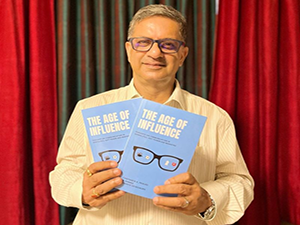
New Delhi (30.07.2025): The book 'The Age of Influence' by Chaitanya K Prasad, Zoya Ahmad and Vaishnavie Srinivasan that has collection of over 50 published articles that trace evolving contours of the communication landscape in recent times. Spanning a wide range of themes including media narratives, public policy, branding, soft power, film festivals, celebrity culture, sports diplomacy and geostrategic communication.
It has been curated to mirror the complexity and dynamism of the communication domain as it exists today. The architecture of communication has undergone significant shifts over the past year which has moved from being a static system of transmission to becoming a living, ever-changing mechanism that shapes how individuals, institutions, and nations perceive and are perceived.
The traditional boundaries between message, medium, and meaning have blurred. Every issue from political, cultural, social to cinematic has been debated and reframed in real time across a media landscape that is more interconnected and volatile than ever. The objective of this compilation is not to offer conclusions, but to open windows.
The book reflects the diverse forms and functions of communication, its tone, its reach, its rhythm, and its role in both subtle and significant shifts. Each article is presented not merely as a standalone commentary, but as part of a larger tapestry that speaks to the centrality of narrative in shaping both policy and public imagination.
A conscious effort has been made to preserve the multidimensionality of the communication discourse. Themes have been approached with an awareness of their interplay, how a branding campaign intersects with diplomacy, how cinema translates into soft power, how a moment of virality reveals deeper truths about 1 social sentiment.
The perspectives offered in this book position communication not merely as a channel of dissemination, but as a powerful site of negotiation and identity formation. Another dominant thread running through this compilation is the influence of cinema and celebrity culture in shaping collective consciousness.
It invites engagement from across sectors, policy, media, academia, governance, and culture. Each reader is encouraged to navigate the collection freely, to form their own associations, and to interpret the essays not as absolute truths but as entry points into larger conversations.
The book is result of conversation between author and audience, event and reflection, idea and impact. Ultimately, this book is not meant to be read linearly. It is a fluid archive. Readers may start from any point, jump across sections, return to earlier pieces, or simply pause at themes that resonate. What is hoped is not agreement, but engagement. Not closure, but curiosity.
As the pace of change accelerates and the information ecosystem grows ever more complex, the task of reflection becomes more critical, not to slow down progress, but to anchor it. This book, then, is offered as one such anchor. A place to pause, reflect, and return to. A curated collection of moments and meanings, bound by the belief that communication is not peripheral to change, it is central to it.