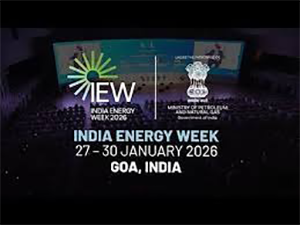
Panaji (27.01.2026): The fourth edition of India Energy Week (IEW) is taking place in Goa from January 27 to 30, 2026 under the patronage of Union Ministry of Petroleum and Natural Gas in association with Federation of Indian Petroleum Industry (FIPI) and dmg events. India Energy Week 2026 will unite policymakers, business leaders, innovators and investors to drive pragmatic solutions for a secure, sustainable and affordable energy future.
The event will spotlight India’s growing leadership in balancing energy access with decarbonisation goals, highlighting strategic investment opportunities, breakthrough technologies and enabling global partnerships that are shaping the next era of energy progress as India strengthens its role at the heart of the global energy transformation.
While speaking at the event via video conferencing, Prime Minister Narendra Modi said that India has emerged as a land of immense opportunities for the global energy sector, underlining that the country is moving beyond energy security towards the larger goal of energy independence. Representatives from nearly 125 countries have gathered in Goa to deliberate on building an energy-secure and sustainable future. The event has evolved into a major global platform for dialogue and action in the energy sector.
Highlighting economic growth of India, Narendra Modi said the country’s rising energy demand also presents opportunities to meet global requirements. He pointed out that India is among the top five exporters of petroleum products, supplying to over 150 countries, and added that this capability would benefit international partners seeking reliable energy solutions.
With a strong call for cooperation, resilience, and inclusive growth by the event, Union Minister for Petroleum and Natural Gas Hardeep Singh Puri outlined India’s expanding role in the global energy landscape. Delivering the Welcome Remarks and Inaugural Ceremony Keynote Address on Day One of the event, the Minister described IEW as a rapidly maturing global platform that brings together policy, industry, innovation, and leadership. He said IEW 2026 reflects the steady evolution of the platform into one of the world’s most significant gatherings for energy dialogue and collaboration.
The Prime Minister further described the upcoming India-European Union Free Trade Agreement as a historic milestone that is being hailed globally as the “mother of all deals.” He said the agreement will reflect exceptional coordination between two of the world’s largest economies and it will represent nearly 25 per cent of global GDP and about one-third of global trade. The FTA would complement India’s recent trade agreements with the UK and EFTA countries, strengthening global supply chains. The agreement would boost manufacturing and expand the services sector, while enhancing investor confidence in India.
Emphasising India’s openness to global partnerships, the PM said the energy sector alone offers vast opportunities across the entire value chain. Reforms in the exploration sector and referred to the Samudra Manthan Mission, India’s deep-sea exploration initiative. By the end of the decade, India aims to attract $100 billion in investments in oil and gas exploration and expand exploration coverage to one million square kilometres.
Over 170 exploration blocks have already been awarded, with the Andaman and Nicobar basin emerging as a promising hydrocarbon region. Reforms such as the reduction of No-Go areas and regulatory changes, incorporating feedback from previous Energy Week editions, have made the sector more investor-friendly. India’s strong refining capabilities ranks second globally and is on track to become the world’s largest refining hub. India’s refining capacity of around 260 million metric tonnes per annum is expected to cross 300 MMTPA in the near future.
On Liquefied Natural Gas (LNG), the PM said India aims to meet 15 per cent of its energy demand through LNG and is investing across the entire value chain. He referred to a ₹70,000-crore shipbuilding programme to support domestic LNG transportation, along with new LNG terminals, regasification facilities, pipelines, and expanding city gas distribution networks.