New Delhi (18.12.2020): Officials are wondering whether electronics industry associations will at all cooperate in joining PM Narendra Modi's concern on mounting electronics waste. Their concerns have arisen because of the influence peddled by the industry when it comes to discharging its responsibility to the environment and Indian lives.
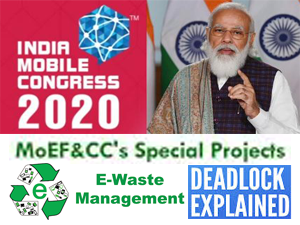
On December 8, 2020, addressing the virtual meeting of India Mobile Congress 2020, the PM had this to say: "Due to technological up-gradation, we have a culture of replacing handsets & gadgets frequently. Can the industry form a task-force to think of a better way of handling electronic waste & create a circular economy?"
In view of the past behavior of the representative bodies of the electronics industry, the question being asked is why it has been so difficult for the electronics industry to blend growth (or 'atmnirbhar Bharat' in electronic goods) with PM's general emphasis on 'swacchta' (cleanliness)? Or the ease of doing responsible business!
The officials seem to be asking whether the electronics industry needs another package of incentive for cleaning up its mess? Does one really need an incentive to, say, clean up one's own toilet or to keep one's environment clean? - is the question being asked.
From the electronics industry perspective, it may seem that it does need payment from taxpayers to clean up its garbage and make money from turning the garbage into useful commodities. Otherwise, it may pretend to work on this without delivering.
To get an idea of what profit sharks do, let's go back to March 23, 2016, when the MoEFCC notified the new E-Waste Management Rules 2016. These rules listed out the measures for effective collection for the “ end of life” electronics products.
To build a circular economy, electronic goods manufacturers were tasked to set up mechanisms for the collection of e-waste and their recycling.
General targets were fixed for all types of electronic industry from the second year to reach 90% in 7 years.
And lo and behold! Hell broke loose. Industry associations, particularly the India Cellular and Electronics Association (ICEA) and its most versatile and dynamic chairman Pankaj Mohindroo with 'rare' connections deep inside the government, got excited. And they pleaded with, and prevailed over, the MoEFCC, Meity, Telecom Ministry, DIPP, and PMO, to relax the e-waste collection and recycling rules for them as, otherwise, their efforts to accelerate the growth of the mobile and electronics industry may run into an unmovable obstacle.
The maximum the industry could do, industry bodies said, was to set up a fund from their side with 'donations' from the government to make a symbolic gesture towards Green India by setting up mechanisms to trace discarded mobile phones and nothing beyond that.
According to sources in MoEFCC, the industry's attitude was so 'negative' and 'preposterous' that the then Meity Secretary, Ms. Aruna Sharma (Retd IAS:1982:MP), and MoEFCC Additional Secretary MM Kutty (Retd IAS:1985) declined to entertain the industry's proposal.
However, the PMO, now a zealous votary of comprehensive and green e-waste management, in the formal way of overruling the Ministry sent queries in November 2016 and January 2017 to MoEFCC, attaching the notes from ICEA, CII, and Ficci.
Senior officials in MoEFCC handled those queries, held meetings with all industry representatives concerned, clarified all their doubts and misgivings, and agreed, with approval from the top, to amend certain modalities in the rules for collection targets.
According to some persons in the Ministry, the only representative body that remained opposed, and whose opposition verged on hostility, was the ICEA and its inflexible chairman Mohindroo. The latter wrote again to the PMO which, then, directed the MoEFCC to resolve the issue. A meeting was held in February or March 2017. MoEFCC SecyA N Jha and telecom secretary Aruna Sundararajan (Retd IAS:1982:KL) jointly chaired the meeting. The ICEA again harped on its exclusive right to be excluded from any responsibility in matters of e-waste management despite being advised that the country ought to not wait for another specialized UN agency like for Climate Change to bring all the nations together to address the menace of the e-waste.
A deadlock followed.
To get its demand fulfilled, the ICEA Mohindroo developed ideas. It sent a letter to the PMO, fabricating charges against the Ministry. In early June 2017, the PMO forwarded Mohindroo's letter to MoEFCC. The then Joint Secretary in charge in the PMO was explained the facts of the case as they were.
Apparently, the statement of facts of a senior MoEFCC official didn't carry as much weight as Mohindroo's and ended up in a pernicious decision to remove the official from the Centre.
And sometime in early 2018, the rules were amended and a deceptive sentence was inserted to fulfill the desire of Mohindroo and his cohorts.
Now after 3 years, the PM has felt it necessary to highlight the necessity of e-waste management. If the government had not tied itself with the knots of demands from industry in 2017, MoEFCC would have taken the country forward to manage 50% of its e-waste by 2021 versus the drastically scaled-down target of 10%.
(By Rakesh Ranjan & M K Shukla)