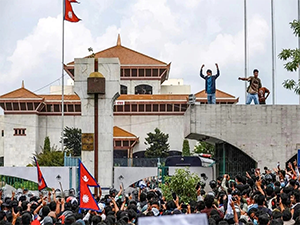
New Delhi (12.09.2025): Nepal is all set to get a new Prime Minister or administrator after Nepalese Prime Minister K P Sharma Oli and President Ram Chandra Poudel had resigned in view of protest by the so-called Gen Z, people born between 1997 and 2012. Oli fled the country after the protests turned violent. Justice Sushila Karki, former Chief Justice of Nepal is leading the race to become the caretaker Prime Minister of Nepal. Sudan Gurung, president of the ‘Hami Nepal’ and a prominent face of the ongoing protests, declared his faction’s support for former Justice Karki.
Exposed to social media right from the birth, Gen Z is vulnerable on many counts which types more and speaks the least. But suddenly they took to street shouting and demanding basic rights to be restored that included access to social media too. It appears to be more than what it looks. Moreover, this may not amuse Gen X, who are the category of parents of Gen Z, that denial of social media access might have caused violence and killing over 52 people so far but the problem seems to be real.
Gen Z forms its ideas by accessing social media. So, the protest that began after a ban on Facebook, X, Instagram and YouTube spiralled into a condemnation of corruption in the Nepali government. It was not enough to placate protesters by lifting ban on social media who carried placards with slogans like 'shut down corruption and not social media', 'unban social media', and 'youths against corruption' as they marched through Kathmandu, while videos with hashtags like #NepoBabies, and #PoliticiansNepoBabyNepal flooded social media. The issue of Nepo Kids too figured in the protest later on.
Oli had left Kathmandu on an Army chopper and negotiations are on for the new government to be installed but if the Army takes over, it would be mirror events of Sri Lanka in 2022 and Bangladesh in 2024 while in the case of Pakistan, there is a puppet government of Prime Minister Shehbaz Sharif run by puppeteer Field Marshal Asim Munir. Former Prime Minister Imran Khan accused America of regime change in Pakistan. Economic crisis, shortages of medicine, fertilizers and protest against corruption forced governments of Mahinda Rajapaksa of Sri Lanka while a major allegation against Sheikh Hasina of Bangladesh was rigging in elections forcing them to step down.
The role of US suspected
The US deep state has been in the game for long and the global superpower is accused of toppling over 50 regimes of the world for its own benefits. What they have done to Iran, Iraq, Venezuela, Afghanistan and many others is not hidden to anyone but the growing economic prowess of India is a new challenge. The role of the US in the coup in Bangladesh is no longer a secret and forcing Imran Khan to step down was accused by the leader himself. Instability in Pakistan and Bangladesh is a serious threat to India that it knows very well. The same US factor as it allegedly worked in Pakistan and Bangladesh can’t be denied in Nepal for two reasons; First it may give a message to China that it has access to its courtyard and second message is for India to come to terms with the US president if it doesn’t want to deal with too many fronts. Instability in Nepal and Bangladesh may pose a serious security challenge and terror threats to India by Pakistan using Nepalese soil.
How did China let this happen?
Oli is known for his allegiance to China and regime change in Nepal could be a message for China which was trying to rally global leaders by organising SCO summit and Chinese role in BRICS. Removal of Oli is a message for China by the US that it is still in the game in South Asia which has already intensified its activities in Baluchistan at the cost of China which has reportedly become active in Baluchistan to counter the US there. The US appears to be damaging the business prospects of China everywhere from Nepal, Baloochistan, Gulf and Africa.
Concerns for India
India too claims to be the victim of conspiracies of foreign players that want to destabilise it to derail it from the path of growth and development. Singer Miya Khalifa protesting against CAA and rallies organised in Montreal, Toronto and other Canadian cities against Farm Laws passed by the government of India under Narendra Modi are clear examples of foreign hands to destabilize India. Violent protests against Agniveer Scheme and many others. The role of foreign hands in the disturbance in Manipur is one among many examples but India managed to withstand such onslaught so far due to its strong democratic strength. The attack in Pahalgam on Hindu tourists by asking their faith was part of the bigger gameplan. Billionaire George Soros openly announcing $1 billion to destabilise India and Austrian economist Gunther Fehlinger-Jahn post on X to dismantle India are some testimonies to fact that forces are active to do the same what Nepal is witnessing. Some of the Opposition leaders have no qualm in saying this also that India too may face the same.
Volatile Neighbourhood
The entire Indian neighbourhood is now destabilised with Pakistan, Afghanistan, Bangladesh, Sri Lanka, Myanmar and Maldives struggling for a consistent regime. India is the only country that seems to be not only growing but managed to foil any attempt made by the foreign players to cause situations like Bangladesh or Nepal. It doesn’t mean that things are hunky-dory in India but the country is battling hard to deal with such elements. There are consequences of the disturbed neighbourhood that India would have to deal with for peace to prevail in the region for being a nation that cherishes democratic values which is core to its people.
Demand for Monarchy returns
With the Union Home Ministry flagging demographic change along India-Nepal border and also Nepal witnessing the same, there is a potent threat that Pakistan might use Nepalese soil to unleash terrorist activities in the country to avoid unpausing Operation Sindoor. Pakistan had used Nepalese soil against India on many occasions in the past. The indulgence of China in Nepal has driven its people and the government away from India. A big section of Nepalese people considers India as the trusted ally while the Nepalese government is close to China. Despite efforts being made, peace in Nepal may not return soon as besides Gen Z, Maoists who overthrew Monarchy in Nepal and pro-monarch groups are active now. They claim to be stakeholders and will try to get their pound of flesh by any means that Maoists already had. Now, its turn for the other two players.
Amid various names surfacing like Sudan Gurung and organisations like Hami Nepal for orchestrating protest and Hami Nepal getting funds from the US and Kathmandu mayor supporting the Gen Z, the matter may take long to get resolved. But it is a big lesson for India to learn.
(By Vinod Kumar Shukla)