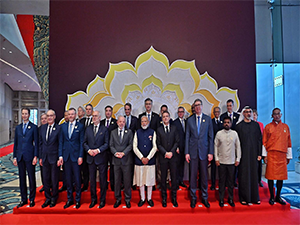
New Delhi (20.02.2026): Keeping aside the controversy caused due to a private player in the India AI Impact Summit 2026 in New Delhi that might have proved to be a moment of redeeming political capital for Opposition political parties in India, which is their constitutional right, but the event not only registered a resounding success but proved to be a watershed movement in technological development, upgradation and global acknowledgment of India being one of the key players.
To water down the controversy, Union minister Ashwini Vaishnav not only took the blame of the goof up of a private player but also apologised to puncture the narrative of the Opposition block but still there is a section who was not ready to settle with anything less than his scalp. But when politicians were trying to score some brownie points for domestic consumption, India was writing a history in the field of AI which has a lot of opportunity to offer. India has made the entire world to run a race where reaching the finish line together is preferred over anyone winning it. So, the Global South that India wants to grow along with the rest of the world is also counted on.
To put the said controversy in perspective, visiting officials of Commonwealth Games in 2010 of Delhi described bathrooms of Commonwealth Village specially prepared for the occasion as "filthy," with blocked toilets, faeces in places it shouldn't be, gutka-stained basins, and stray dog footprints on bedding. Even Commonwealth Games Federation (CGF) chief executive Mike Hooper had described the village as "filthy" and "unliveable".
Now, the case where wrongs of a private person can morally and administratively be questioned but not the government policy should be held accountable. For instance, Sochi Winter Olympics in 2014 recorded 55 positive doping cases, Beijing Summer Olympics in 2008 recorded 91 positive doping cases, the highest for a Summer Games and the latest 2024 Paris Olympics saw nearly 55 anti-doping rule violations were reported. Between 1968 and 2020, there have been over 442 positive doping tests, resulting in the stripping of at least 173 medals. Can the government holding Olympic be made accountable for the actions of athletes. But besides controversy, there were many important take aways.
India’s MANAV Vision and AI for the Global South:
Prime Minister Narendra Modi unveiling of 'MANAV' -- Moral and ethical system, Accountable governance, National sovereignty, Accessible/inclusive technology, and Valid/legitimate AI systems – has outlined India’s vision for technological advancement with human touch. This is where India’s role becomes all the more important as it wants to ensure that AI benefits developing nations too rather than being monopolized by a few countries or companies, emphasizing democratization, inclusivity, and public good. The PM Narendra Modi called for giving AI an "open sky" for innovation while keeping the "reins" in human hands to ensure ethical and safe deployment. These are certain important features of the event not only making the success resounding but would also create a new global business preposition.
Infrastructure & Investment:
Positioning itself as an AI powerhouse, India with massive investments in "sovereign" AI infrastructure, including a $1 billion AI mission, a Rs 10,300 crore investment to secure 58,000+ GPUs, and a 1 GW AI hub in Vizag. Initiatives like "IndiaAI Kosh" highlighted to provide researchers and startups with access to high-quality data (7,400+ datasets) and compute at subsidized rates. Advocating the need for investment in compute infrastructure and connectivity, Google CEO Sundar Pichai and other honchos warned against allowing the digital divide to become an "AI divide". It is now shifting from hype to real-world value with around 90 per cent Indian companies re-evaluating strategies to integrate AI and a massive push for AI skill training.
Key Announcements & Projections:
Sam Altman of OpenAI predicted that by 2028, AI systems could surpass human experts in many fields, and noted India is ChatGPT's second-largest market. Reliance Industries led by Mukesh Ambani pledged to invest $110 billion over the next seven years to build India's AI ecosystem. Microsoft too has pledged a huge investment to the tune of $3 billion for AI and cloud infrastructure in India and plans to train 10 million people in AI skills. But the most important aspect of the event is that it drew over 35,000 participants from 100+ countries, including 15+ heads of government and 40+ global CEOs.
A roundtable with CEOs & deeptech Startups
CEOs and founders of 16 AI and deeptech Startups presented their ideas and work to Prime Minister of India who held a roundtable with them at Seva Teerth (PMO) on February 20, 2026. The startups participating in the roundtable are tackling population-scale challenges across key sectors. In healthcare, they use AI for advanced diagnostics, gene therapy, and efficient patient record management to extend quality care to the last mile. In agriculture, they leverage geospatial and underwater intelligence to boost productivity and help manage climate risks. The group also includes ventures focused on cybersecurity, ethical AI, space, social empowerment through vernacular access to justice and education, and modernising legacy systems to strengthen enterprise productivity. Together, they reflect an ecosystem addressing local needs while building global leadership in AI-driven innovation. The meeting at Seva Teerth was attended by CEOs and Founders of Abridge, Adalat AI, BrainSightAI, Credo AI, Eka Care, Glean, Innogle, Invideo, Miko, Origin, Prophaze, Rasen, Rubrik, SatSure, Supernova and Sypha AI.
India joins Pax Silica coalition
On the fifth day of the India AI Impact Summit 2026 that was inaugurated by the PM, India formally joined the Pax Silica coalition, marking a significant milestone in the strengthening of strategic technology and supply chain cooperation between India and the United States who is the leader in AI. The signing ceremony brought together senior government leaders from both nations, underscoring a shared commitment to securing the full technology stack that will power the AI-driven global economy.
Pax Silica is envisioned as a strategic coalition of trusted nations committed to securing the “silicon stack”, from critical minerals and semiconductor fabrication to advanced AI systems and deployment infrastructure. The initiative seeks to reduce overconcentration in global supply chains, prevent economic coercion, and ensure that emerging technologies are developed and governed by open, democratic societies.
The summit, despite some initial logistical challenges, controversies and political brickbats at the government, set a new, inclusive agenda for the future of AI governance, with a strong focus on public interest and national sovereignty.
(By Vinod Kumar Shukla)