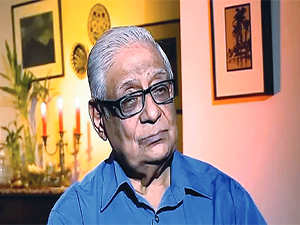
New Delhi (09.03.2026): There are journalists who leave behind a body of work. And then there are journalists who leave behind a way of being. H K Dua belonged unmistakably to the latter tradition — a vanishing lineage of editors for whom journalism was not merely a profession but a form of public conduct.
I first met Dua Sahab in the early years of my career at The Indian Express group. I was then running the research bureau for its financial daily, immersed in numbers and policy briefs, while he headed the news bureau of the flagship paper. His office was what could only be described as a tiny cubicle in the bustling newsroom. But what it lacked in size it made up for in presence.
He greeted people with a smile that seemed permanently poised on his face—warm, unassuming, almost boyish. What struck me even then was how quickly that smile could turn thoughtful, as if the mind behind it was always weighing the world with care. A moment later the smile would return again, restoring the easy civility that seemed to define him.
Dua Sahab was, above all, a gentleman of the newsroom. At a time when journalism can sometimes reward aggression more than judgment, he belonged to an older ethic. He expected colleagues to treat each other with respect without exception. I remember once when a younger but prominent editor had begun raising his voice frequently in editorial discussions. Dua Sahab, then junior to the prominent editor, did not react openly. Instead, with a mixture of curiosity and concern, he quietly asked colleagues whether such behavior was normal now, whether it was considered acceptable. It was a simple question, but behind it lay a worldview: that journalism should never abandon civility.
The newsroom he inhabited had its own remarkable constellation of personalities. Dua Sahab reported to the affable A N Dar, whom we all called Dar Sahab, who in turn reported to the legendary Kuldeep Nayar. Together, they represented a generation of editors whose authority came less from hierarchy and more from moral stature.
Kuldeep himself never quite had the opportunity to lead a newspaper in the way his influence deserved. But he briefly served as India’s High Commissioner to the United Kingdom — one of the most coveted diplomatic roles of its time. Years later, Dua Sahab too would enter diplomacy, serving as India’s ambassador to Denmark. It was a fitting extension of a career rooted in the careful observation of the world.
Both Kuldeep and Dua Sahab would eventually find their way to the Rajya Sabha, India’s upper house of Parliament, where journalists occasionally carry their experience of public life into the legislative arena.
I was once offered a nomination to the Rajya Sabha myself, back in 1988, after Khushwant Singh. In my youthful idealism, I declined. At the time I believed — perhaps somewhat naively — that the role of an editor was more meaningful than that of a nominated legislator. Looking back now, I recognize that the paths taken by men like Dua Sahab demonstrated that the two callings could complement one another.
Among my strongest memories of him is one that captures his instincts as a newspaperman.
During the years when I was editing Dinamaan at The Times of India Group, a violent shootout erupted in my neighbourhood around midnight. It was the sort of chaotic urban moment that can easily disappear into rumour by morning. I picked up the phone and woke Dua Sahib.
Within minutes his newsroom was in motion and turned the incident into the front-page story that opened the newspaper that morning. Competing papers would carry the news only in later editions.
It was classic Dua Sahab—calm, efficient, instinctively aware that journalism’s first loyalty is to the immediacy of truth.
Our professional paths continued to intersect over the years. I remember with some surprise the day I learned he was taking over as editor of the Hindustan Times while I was editing Dinamaan. Over time he would achieve something almost unmatched in Indian journalism: editing four of the country’s major newspapers—Hindustan Times, The Indian Express, The Tribune, and The Times of India.
Few editors in the history of Indian journalism have commanded that kind of trust across institutions.
Despite the demands of such a career, Dua Sahab remained remarkably accessible. Every few months we would meet to catch up—discussing journalism, politics, and the changing character of public discourse. When he later served in the Rajya Sabha, he would often send me copies of his speeches. They reflected the same clarity and moderation that defined his editorial voice: firm without being strident, thoughtful without being evasive.
He also holds another distinction that speaks to the respect he commanded across the political spectrum. He served two prime ministers as their Information Adviser—an honour rarely extended to editors and never lightly given.
To think of him today is to see again that alternating expression: the smile and the thoughtful face. One suggested warmth; the other judgment. Together they formed the character of a man who believed that journalism, at its best, is an act of public trust.
At 88, many would say he lived a long life. Yet by the standards of our time, it feels unexpectedly brief. Perhaps that is because Dua Sahab seemed to belong to a generation that carried within it the institutional memory of Indian journalism—the years when editors believed their responsibility was not only to inform the public but also to elevate the tone of public life.
In remembering him, I find myself thinking not only of his remarkable career but also of the quiet civility he brought to every room he entered. The newsroom cubicle, the ambassadorial residence in Copenhagen, the chamber of the Rajya Sabha—each, in its own way, bore the imprint of the same temperament.
Dua Sahab lived fully, edited courageously, and conducted himself with a grace that now feels increasingly rare.
And when I think of him now, what returns first is that smile—quick, generous, and thoughtful—still flickering in memory like the opening light of a newsroom at dawn.
(By Satish Jha)