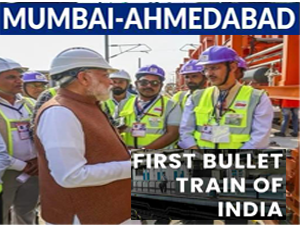
Surat (18.11.2025): Just days after the conclusion of the crucial Bihar Assembly elections, Prime Minister Narendra Modi swiftly resumed his focus on flagship infrastructure projects, visiting the under-construction Mumbai–Ahmedabad High-Speed Rail Corridor station in Surat, Gujarat, on Sunday.
The Prime Minister held extensive interactions with the project team, seeking an in-depth review of the progress of what will be the nation's first bullet train line. Team members assured the PM that the monumental project was progressing without technical delays and was adhering to both speed and timeline targets. Modi was also briefed on the rigorous design and engineering control processes being implemented to ensure the project meets international standards.
Lessons for Nation-Building:
Highlighting the project’s significance beyond its immediate commercial value, PM Modi stated that the experiences and innovations gained are being meticulously recorded and compiled into a 'reference book.'
"The lessons learned in the bullet train project are not just for this one line, but for the country’s future," Modi said. "This documentation will help India move decisively towards large-scale implementation of similar high-speed rail networks, benefiting future students and contributing to nation-building."
Engineering and Economic Impact:
The 508-km corridor, which covers 352 km in Gujarat and Dadra & Nagar Haveli and 156 km in Maharashtra, is designed to be a game-changer for the regional economy, expected to catalyze business, tourism, and overall economic activity. Once operational, the train will drastically cut travel time between Mumbai and Ahmedabad to about two hours.
Project statistics presented to the PM underscored the scale of the engineering feat:
- 465 km of the track will be built on viaducts to minimize land disturbance and enhance safety.
- The team confirmed that 326 km of viaduct work is already complete.
- 17 of the 25 major river bridges required for the route have been successfully constructed.
- The bullet train will connect key cities including Sabarmati, Ahmedabad, Vadodara, Surat, Vapi, Thane, and Mumbai, marking a transformative step in India’s transportation future.