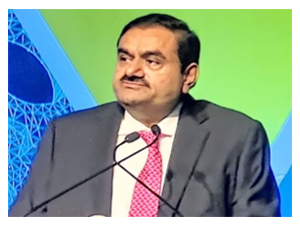
New Delhi (29.12.2022): The phenomenal growth of the Adani Group is no less than a fairy tale for some but only the first-generation entrepreneur Gautam Adani can tell you how much hard work, consistency, perseverance, management, faith on colleagues and appropriate use of policy changes enacted by various governments helped the group to grow and achieve where it is today. His group owns the largest private sector power producer, port operator, airport operator, consumer gas business and electric transmission company apart from being the largest infrastructure developer in renewables in just three decades. The second largest cement manufacturer is diversifying rapidly into other sectors including aircraft maintenance, manufacturing, telecom, data centres and logistics with a personal net worth of $150 billion, Adani is now the richest Indian overtaking Mukesh Ambani of Reliance. Gautham Adani is hopeful of India becoming a $30 trillion economy by 2050.
With a successful Adani Wilmar IPO, which has become the seventh listed company in the Group that started business from scratch, made it profitable and then went public. The group acquired ACC and Ambuja Cements for around $10.5 billion. A god-fearing man who thanks God for giving him the opportunity to serve the nation through infrastructure building. On his 60th birthday, the family committed Rs 60,000 crore to the Adani Foundation to support people in the field of education, healthcare and skill development.
First the most important issue: His relations with PM Modi!
Adani is targeted for his proximity with the Prime Minister just for being a fellow Gujarati. It makes him an easy target with baseless allegations but certainly not vulnerable. His growth can be measured in various phases which began during Rajiv Gandhi as Prime Minister when he liberalized Exim policy and for the first time several items were brought in the OGL list. This is the time when Adani started his export house. In 1991, Prime Minister P V Narasimha Rao and Finance Minister Manmohan Singh initiated economic reforms of which Adani too was a beneficiary like any other entrepreneur.
When Keshubhai Patel became Gujarat CM in 1995, he focused on coastal development and policy change took Adani to Mundra to build its first port. Under the then Chief Minister Narendra Modi in 2001, his policies and their implementation not only changed the economic landscape of the state but also brought social transformation and development of underdeveloped areas. It allowed industries and employment to take off like never before. Under his leadership, a similar resurgence at the national and international levels is visible where a new India is asserting itself. The professional success of Adani cannot be attributed to any individual rather on policy and institutional reforms initiated by various successive governments over three decades.
Prime Minister Modi is trying hard to bring transformative changes not only in the Indian economy but also pushing for social transformation and inclusive growth. He has through several innovative schemes and their effective implementation, given a strong push to industrial and economic development of India.
What about debt to the tune of Rs 2 lakh crores?
Contrary to observation, the group is financially very strong. Such noises are either from people not diving deep to understand nuances of debt and finances of the company or people with vested interests. In the past nine years, the profit of the company has been growing at twice the rate of its debt, because of which the company's Debt to EBITDA ratio has come down from 7.6 to 3.2, which is very healthy for a large group. And concerns that banks, including public sector banks, have huge exposure to Adani debt are misplaced. The fact is, nine years ago, out of the company's total debt, 86 per cent was lending from Indian banks. But now, the exposure of Indian banks in the company's total lending is reduced to only 32 per cent. Almost 50 per cent of the company's borrowing is through international bonds. International investors are very astute and subscribe after proper due diligence and deep study.
Protest, criticism and allegations…
Protests, criticism and allegations are essential parts of healthy democracy for Adani. It has given everyone economic freedom and opportunities and everyone has benefited from it. Now, no one should complain and cherry-pick about other aspects of democracy which have their own functional values within the boundary of law. Moreover, giving up has never been part of Adani’s culture. Over the years, the Group has developed a strong and professional team with endless energy and a problem-solving approach. It has always been looking at solutions. Gautam Adani has a motto: ‘Never waste a crisis’.
Solar and hydrogen: Betting big on green energy:
Green energy is in thing with the special focus of the country to reduce carbon footprint. Adani Group considers it as its responsibility towards future generations. The Government has brought a very attractive production-linked incentive scheme (PLI) which has made the green hydrogen business viable and attractive. In fact, the group is not only confident that with this enabling support it will not only meet domestic demand but soon become a green hydrogen exporter.
India’s growth in the years ahead?
It took India 58 years to get to its first trillion dollars of GDP, 12 years to get to the next trillion and just five years for the third trillion. But now, if you look at the pace of social and economic reforms, India can be adding a trillion dollars to its GDP every 12 to 18 months within the next decade. People are very optimistic about the growth and prosperity of India. This optimism comes from the fact that by 2050, India will have a young India of 1.6 billion people with a median age of 38. The country will also have the world’s largest middle-class population. This demographic dividend combined with the largest middle class will spur growth and prosperity in India making it a $30 trillion economy. So, clearly, this century belongs to India.
The Global recession rebuffed:
As far as the global recession in 2023 is concerned, India was successful in beating the prediction in 2008. A strong focus on capital expenditure, employment, social infrastructure and social security will help in facing the global headwinds of recession and India will emerge stronger.