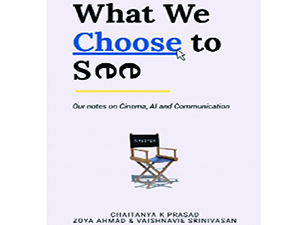
New Delhi (26.07.2026): Every generation inherits the same world, but no two generations see it in quite the same way. What changes is not merely technology or politics, but the lens through which we interpret them. Today, that lens is being shaped simultaneously by cinema, artificial intelligence and communication—three forces that influence not only what we know, but also what we believe, remember and ultimately choose to see.
Cinema has always been more than entertainment. It reflects our aspirations, preserves our histories, challenges our assumptions and quietly shapes our collective imagination. Artificial intelligence, meanwhile, is redefining how information is created, curated and consumed, raising questions that extend far beyond technology into ethics, governance, creativity and human agency. Communication remains the thread that binds these worlds together. It is through communication that ideas gain meaning, policies gain legitimacy, institutions build trust and societies negotiate change.
Although these themes may appear distinct, they are deeply interconnected. Stories influence technology, technology transforms communication, and communication, in turn, reshapes the stories societies tell about themselves. Understanding one increasingly requires understanding the others.
This book emerged from that realisation.
Many of the essays in these pages first appeared in the columns of prominent newspapers. They were written in response to contemporary events, evolving debates and moments that invited reflection. Yet as we revisited them, a larger pattern began to emerge. Beneath the immediacy of headlines lay enduring questions about perception, responsibility, innovation, culture and public discourse. Rather than presenting isolated commentaries, we sought to weave together a conversation about the forces that are quietly redefining our world.
The essays move across diverse landscapes. Some explore the changing language of cinema and the place of Indian storytelling on the global stage. Others examine the opportunities and dilemmas presented by artificial intelligence, particularly as India seeks to shape an inclusive, ethical and globally relevant AI ecosystem. Several reflect on diplomacy, governance, media, public communication and the power of narratives in influencing institutions and societies. While the subjects vary, the underlying inquiry remains constant: how do ideas travel, how do perceptions form, and what responsibilities accompany those who shape them?
Our intention has never been to provide definitive answers. The world is changing too rapidly for certainty to be a lasting companion. Instead, we hope these essays encourage readers to pause, question familiar assumptions and engage more thoughtfully with the transformations unfolding around them. In an age defined by abundant information but increasingly fragmented attention, thoughtful observation has become an act of responsibility.
As this is our third book together, it also marks another chapter in our own journey as writers. Over the years, our conversations have evolved, our perspectives have widened and our conviction has deepened that meaningful public discourse thrives when different disciplines are allowed to speak to one another. Cinema cannot be understood without culture, technology cannot be separated from society, and communication is most effective when it is grounded in empathy, clarity and purpose. This book is an attempt to bring these conversations into a shared space.
We are deeply conscious that every essay represents only one perspective among many. We invite readers not merely to agree or disagree with our arguments, but to continue the dialogue—to question, to reflect and perhaps to see familiar issues through a different lens. If these pages inspire conversations that extend beyond the final chapter, they will have fulfilled their purpose.
Ultimately, this book is about perception. About recognising that the world is rarely defined solely by what happens, but by how we understand it. In an era of relentless information, perhaps the greatest challenge before us is not learning to see more, but learning to see better.
We hope that these pages encourage exactly that.