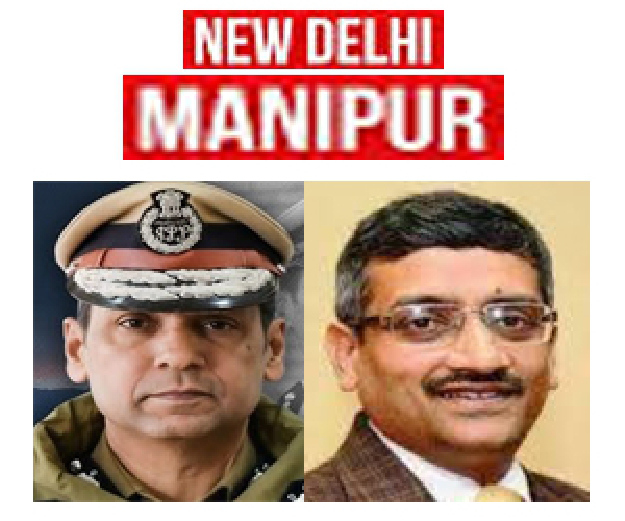
NEW DELHI (23.05.2026): The Union government’s decision to appoint Mukesh Singh (IPS: 1996: AGMUT) as the new Director General of Police (DGP) of Manipur is a definitive statement of intent. The Centre on Thursday notified the inter-cadre deputation of Mukesh Singh for a period of three years in
relaxation of the conditions of inter-cadre deputation and waiving of the
mandatory “cooling off” period after central deputation as a special case in
public interest while formal orders of his appointed as DGP is yet to be made public.
This
news appointment has many administrative contours including holding early elections
in trouble-torn Manipur. It underscores a growing assessment in New Delhi that the ethnic conflict and systemic administrative paralysis in the northeastern state require a direct, centralized security intervention, completely insulated from local political dynamics.
Mukesh Singh, DGP of Ladakh, now replaces Rajiv Singh (IPS: 1993: TR) who has been moved from Manipur to the Centre as Secretary (Security) in the Cabinet Secretariat after a challenging tenure in Imphal.
The AGMUT Double-Engine Command:
The policing transition completes a critical structural pivot in Manipur’s top administrative tier. Singh’s appointment means that both the administrative and internal security apparatuses of the state are now helmed by officers from the Union Territory (AGMUT) cadre. Puneet Kumar Goel (IAS: 1991: AGMUT) already serves as the state’s Chief Secretary.
Placing a non-state cadre IAS officer alongside a non-state cadre IPS officer at the apex of the bureaucracy and police force is a rare administrative manoeuvre. It signals that New Delhi is effectively bypassing regional administrative silos to deal with the prolonged crisis on its own terms.
Neutralizing the Trust Deficit:
The protracted violence in Manipur has long exposed a deep-seated trust deficit cutting across community lines and regional policing echelons. By consistently relying on "outsider" commanders, the Ministry of Home Affairs (MHA) aims to insulate the top leadership from local pressures and the inevitable allegations of partisan bias that have plagued regional forces since the conflict erupted. Deploying external cadre officers is an operational strategy designed to ensure absolute objectivity in field crackdowns, free from the institutional baggage of local equations.
(By Rakesh Ranjan)